Institute for Public Health Innovation (IPHI) Logo

IPHI Receives Capacity Building Grant from the Healthcare Initiative Foundation

IPHI is one of 15 recipients of the Healthcare Initiative Foundations FY18 Capacity Building Grants. The award of $25,000 will support the implementation of Local School Wellness Councils (LSWCs) in public schools in Montgomery County, Maryland. IPHI is currently working with Montgomery County Public Schools through the Healthy Montgomery Transforming Communities Initiative to implement LSWCs in 15 initial pilot schools within the County. Next year, with the help of the HIF grant award, IPHI and MSPS will work to expand LSWCs to many more schools.

For more information read the Healthcare Initiative Foundation’s Press Release here.

Why Equity Matters: Creating Healthy Communities

Thursday, April 26, 2018 1:30 – 2:30 p.m. EDT

Join the Institute for Public Health Innovation for a 1-hour webinar to explore health equity and why equity matters. The webinar will highlight data related to health equity in the Virginia, DC, and Maryland region. It will also provide an overview of the 1-day, in-person workshop that IPHI will conduct on May 31, 2018 that provides tools that professionals and grassroots leaders can use to promote improved health for all residents of their communities.

Learning Objectives: In our communities, there are groups who systematically experience higher rates of disease and mortality across many physical and mental health conditions. These inequities prevent individuals, families, and communities from enjoying long, productive lives and reaching their full potential.

At the conclusion of this webinar, participants will be able to:

  • explain key terms such as equity and population health;
  • recognize why equity matters in their work; and
  • describe how implementing an equity lens can help families and communities meet their full potential.

To register for this course, please click on the link below:

https://zoom.us/webinar/register/WN_GnwspX4xQnyna1HA6Jn5TA

Gaithersburg Elementary School Showcases Wellness

Gaithersburg Elementary School Showcases Wellness in Montgomery County

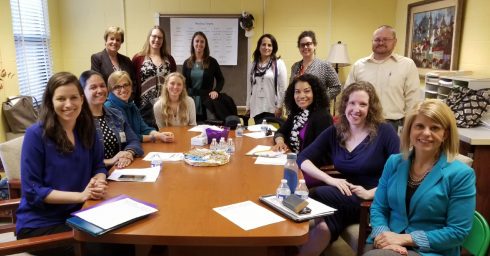
On April 10th, the Healthy Montgomery Transforming Communities Initiative (TCI) partners from IPHI, Trinity Health, Holy Cross Health and the Eat Well Be Active Partnership visited Gaithersburg Elementary School (GES), one of 15 Montgomery County Public Schools implementing Local School Wellness Councils (LSWCs) with support from the TCI.


Left to Right: Michelle Caruso (IPHI), Kimberly McBride (Holy Cross Health), Emily Heberlein (Georgia Health Policy Center), Marla Caplon (MCPS), Jaime Dircksen (Trinity Health), Julia Groenfeldt (IPHI), Beth Geno (Trinity Health), Gaby Massie, (MCPS), Cara Grant (MCPS), Evelyn Kelly (IPHI), Jason Berg (GES), Christine Tilkens (GES), and Principal Meredith McNerney (GES).

As an LSWC pilot school, GES has worked closely with Montgomery County Public Schools (MCPS) and IPHI to train and support School Wellness Champions to implement its LSWC and wellness initiatives in alignment with district-wide policy. The site visit allowed project funders and partners to learn about these efforts from the staff and teachers implementing the work.

The site visit group toured the school, visiting a 4th grade classroom equipped with flexible seating such as cushions, yoga balls, standing desks, and sensory seats, as well as the school mindfulness room where students can reflect and reconnect on an as-needed basis. On the tour, the group stopped by a Zumba class, one of the school’s free after-school clubs that promote physical activity to students and parents. The group also observed the school’s daily mindfulness practice at dismissal led by Principal McNerney. Throughout the visit, teachers and staff noted the benefits of these activities and resources that have helped encourage healthy practices and student behavior change throughout the school.

Next year, IPHI and MCPS will use lessons learned from the 15 pilot schools to create tools, resources, and processes in support of district-wide expansion. This strategy is supported through funding from Trinity Health, the Maryland Community Health Resources Commission, and the Healthcare Initiative Foundation.

For more information on the Transforming Communities Initiative, see Healthy Montgomery TCI.

Consultant – Safe Routes to School GIS Map Designer Montgomery County, Maryland

Apply Now

The Institute for Public Health Innovation (IPHI) is seeking a part-time, temporary consultant to assist the Montgomery County Department of Transportations’ Traffic Engineering and Operations Division in developing a standard map template of walking areas around Montgomery County Public Schools. These activities will be conducted as part of the Healthy Montgomery Transforming Communities Initiative (TCI).

Background:

Background Trinity Health, one of the country’s largest health systems, awarded a multi-year grant to a partnership in Montgomery County, Maryland to implement a range of public health strategies that can reduce obesity, promote tobacco-free living, and address social determinants that impact health outcomes. The local collaborative includes Trinity Health member Holy Cross Health, the Institute for Public Health Innovation, Montgomery County Department of Health and Human Services, and the Eat Well Be Active Partnership (EWBA), which is connected to the county’s local health improvement process, Healthy Montgomery. IPHI serves as the coordinating entity for the Healthy Montgomery TCI, which focuses on the communities of Gaithersburg, Germantown, Long Branch and Takoma Park.

Safe Routes to School is one of five strategies of the TCI. The overall goal of the Safe Routes to School strategy is to increase the number of students in Montgomery County who walk or bike to school. IPHI is supporting the Department of Transportation in their current efforts to conduct Safe Routes to School assessments in the County. IPHI is collaborating with the Department of Transportation efforts to: develop and promote user-friendly Safe Routes to School maps for schools, increase the number of Safe Routes to School bicycle and pedestrian educational and safety trainings in priority zip codes, and increase collaboration for sustainability between Montgomery County Public Schools and the Department of Transportation for future Safe Routes to School programming.

Scope of Work:

Over a 3-month period, the consultant will develop a standard map template of walking areas around Montgomery County Public Schools. Once the template is developed, it will be utilized to generate maps for all schools in the County. The maps will be used as part of the County’s Safe Routes to School program to inform students and families about walking and bicycling routes to/from school and can also identify areas that require improvements. The consultant will work with the Montgomery County Department of Transportations’ Traffic Engineering and Operations Division to complete the following tasks:

  • Create new shapefiles as well as manipulate and edit existing shapefiles.
  • Gather and map out additional infrastructure data when necessary;
  • Develop report with summary of findings and recommendations for next steps;

Qualifications:

This consultant position requires an experienced professional with the following qualifications:

  • Experience using ArcGIS, preferable version 10.0 or higher.
  • Demonstrated organizational and communications skills.
  • Knowledge of Montgomery County, Maryland.

Compensation: The consultant will be compensated up to $25/hour for an estimated 100 hours of work based upon experience plus a stipend for mileage if applicable.

Job Location: Montgomery County Public Safety Headquarters in Gaithersburg, MD. This position may require travel throughout Montgomery County, Maryland.

Estimated Timeframe: April 1 – June 30, 2018

How to Apply: Please submit the following: 1) resume; 2) cover letter outlining interest, and qualifications; and 3) a list of professional references related to this opportunity. Consultant bids should be submitted to Michelle Caruso, [email protected]. Please place “TCI GIS Map Designer” in the subject line of the email when applying. A PDF of the job description can be downloaded here.  Applications will be accepted into the position is filled.


The Institute for Public Health Innovation values a diverse, respectful, and collaborative work environment. We establish and maintain trustful relationships with all staff, contractors, funders, partners, and communities. We believe that hard work, a focus on quality, and a passion for the public’s health are required to improve the well-being of individuals, families, and communities. IPHI looks to all staff and contractors to contribute to the effective implementation of programmatic activities.

The Health Collaborative of the Dan River Region Receives National Recognition through Healthiest Cities & Counties Challenge

The Health Collaborative of the Dan River Region Receives National Recognition through the Healthiest Cities & Counties Challenge

The Institute for Public Health Innovation has been working in partnership with The Health Collaborative of the Dan River Region, VA to support community health improvement planning and strategy implementation through facilitative leadership, technical assistance, and resource development.

In 2016, The Health Collaborative was selected as one of 50 finalists to compete in the Healthiest Cities  & Counties Challenge, a two-year prize competition supported by the Aetna Foundation, American Public Health Association, and the National Association of Counties.

On February 1st, 2018, The Health Collaborative was selected by the Aetna Foundation as a Spotlight Award winner for its efforts to make the Dan River Region a healthier place to live.  The Health Collaborative is one of 10 groups nationally to receive this award.  The recognition came with $25,000 in funding to support the continuation and growth of the Collaborative’s initiatives.

For more information on the Spotlight Award, read The Health Collaborative’s recent press release or visit www.thehealthcollab.com.

Nine HEAL Cities & Towns Recognized at 2017 Virginia Municipal League Conference

For Immediate Release:  October 30, 2017 

Media Contact: 

Julia Groenfeldt, Program and Communications Associate 

Institute for Public Health Innovation 

202.747.3455 

[email protected] 

Nine HEAL Cities & Towns Recognized at 2017 Virginia Municipal League Conference 

Williamsburg, VA —  On October 3rd, at the Virginia Municipal League’s (VML) annual conference in Williamsburg, the HEAL Cities and Towns Campaign for the Mid-Atlantic recognized the health policy achievements of nine Virginia cities and towns. The HEAL Cities and Towns Campaign is a project of the Institute for Public Health Innovation (IPHI), in partnership with the Virginia and Maryland Municipal Leagues and with support from Kaiser Permanente of the Mid-Atlantic States. The Campaign provides technical assistance to municipal leaders to help them create healthy, prosperous communities by adopting healthy eating and active living (HEAL) policies and practices that improve their communities’ physical activity and food environments.

When they join the HEAL Campaign, cities and towns adopt HEAL policy and practice goals to create communities where all people can make healthy choices to eat nutritious food and be physically active. Each year, the Campaign recognizes cities and towns that advance to higher Campaign recognition levels by achieving their healthy eating and active living goals. The 2017 Virginia honorees’ accomplishments included:  the adoption of nutrition standards that ensure that food and beverages provided at workplace meetings and city-sponsored events include healthy options; the provision of healthy options in vending machines in municipal buildings; the incorporation of health and wellness language in a local comprehensive plan, construction of new main street pedestrian safety improvements, and the establishment of a community garden in a food desert.

The following cities and towns were recognized at the VML conference: 

  • The Towns of Ashland, Big Stone Gap, Wytheville, and the City of Falls Church were recognized as new HEAL Campaign members.
  • The Town of Wytheville received the Bronze HEAL Recognition for achieving one new HEAL goal.
  • The Town of Gordonsville and the City of Richmond earned the SilverHEAL Recognition for two new HEAL goals.  
  • The City of Hopewell and the Town of Middleburg received the GoldRecognition for attaining three new HEAL goals. 
  • The Town of Warrenton received PlatinumHEAL Recognition, the highest HEAL achievement award. Cities and towns that advance to the Platinum level have attained Gold status and provide evidence that their healthy eating and active living work reaches across government departments and is being evaluated and monitored.  

The annual VML Conference is an opportunity for city and town municipal officials to gain peer support, build skills and knowledge, and learn about opportunities to enhance their communities. The HEAL Cities & Towns Campaign led a workshop and roundtable at this year’s conference. Staff led a panel discussion where HEAL representatives from the Town of Crewe, the City of Williamsburg, the Town of Lawrenceville, the Town of Warrenton, and the Town of Bluefield shared strategies and examples of how their municipalities have successfully implemented HEAL initiatives. The HEAL Campaign also facilitated a round-table discussion on Aging Well with HEAL: How Healthy Eating Active Living Policies and Practices Promote Older Adult Health. This discussion included individuals from current HEAL cities and towns as well as municipal leaders interested in learning more about the Campaign and how they can bring healthy options to older residents in their communities.

About the HEAL Cities & Towns Campaign:

The HEAL Cities and Towns Campaign provides free technical assistance to local government leaders to help them create healthy, prosperous communities by adopting policies and practices that improve their communities’ physical activity and food environments. HEAL is a project of the Institute for Public Health Innovation, in partnership with the Maryland and Virginia Municipal Leagues and funded by Kaiser Permanente, founding partner. 

For more information, visit the HEAL website at www.healcitiesmidatlantic.org and contact HEAL Program Manager, Sydney Daigle at [email protected], 

About Institute for Public Health Innovation: 

IPHI creates partnerships across sectors and cultivates innovative solutions that improve health and well-being for all populations and communities across the District of Columbia, Maryland and Virginia, particularly those most affected by health inequities. IPHI’s work enhances the environments and conditions in which people live, age, work, learn, and play; strengthens health service systems and public policy; and builds organizational and community capacity to sustain progress.  IPHI is one of over 40 public health institutes across the country and a member of the National Network of Public Health Institutes.

For more information on IPHI, see www.institutephi.org, and follow IPHI on Facebook and Twitter @InstitutePHI.
### 


IPHI Releases the Maryland Food Charter!

For Immediate Release:  October 24, 2017

Contact:  

Evelyn Kelly, 202-407-7086

[email protected]

The Institute for Public Health Innovation Releases the State of Maryland’s First Food Charter

Washington, D.C. –  The Institute for Public Health Innovation (IPHI) releases the “Maryland Food Charter: A Roadmap to a Healthy and Sustainable Food System.” The document contains recommendations for each of the five major food system sectors: production and processing, distribution, access, consumption, and recovery. The Maryland Food Charter is the result of a three-year undertaking that began in 2014 and engaged food policy stakeholders including state legislators across the state of Maryland and aligns with recommendations from various food policy documents.

“These recommendations, if used as guidelines for policy makers and organizations working throughout the food system, can foster collaboration and collective action to align organizations and food coalitions across the state to help build a more robust food system,” said Evelyn Kelly, Senior Program Manager with the Institute for Public Health Innovation.

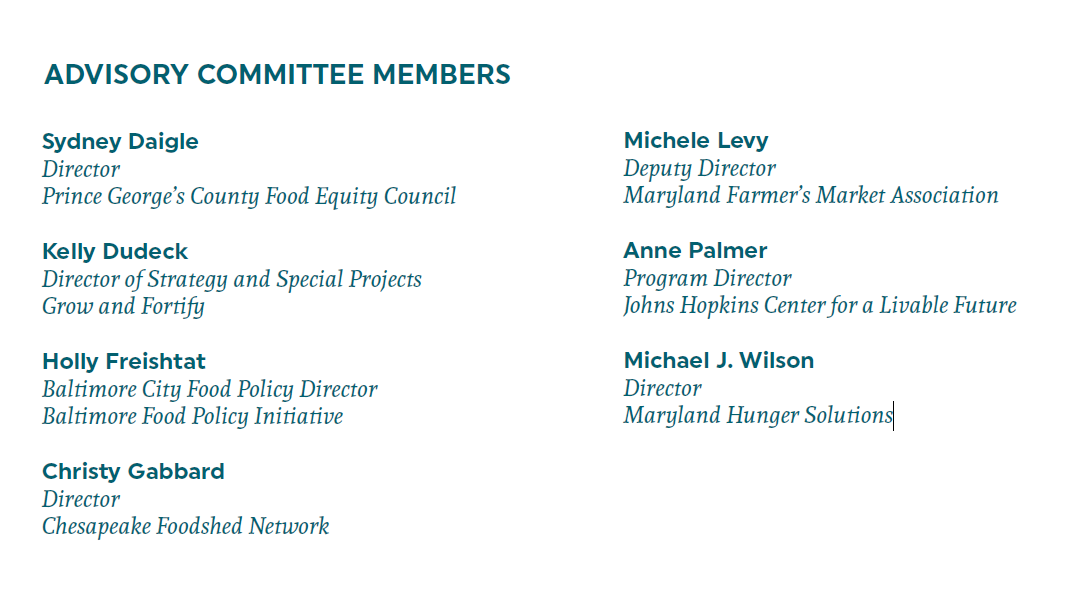
Guiding the planning, implementation, and evaluation of this initiative throughout the years, has been an Advisory Committee composed of eight members that represent multiple food system sectors and interests. The volunteer-based committee along with a Food Charter Coordinator provided critical input and guidance to the effort.

The Food Charter contains recommendations that were developed based on public input from all regions of Maryland, input from state legislators representing 22 districts, and aligns with the  “Maryland Food Policy Scan” and the “Milan Urban Food Policy Act.” IPHI partnered with the Johns Hopkins Center for a Livable Future to commission the Food Law and Policy Clinic of Harvard Law School to conduct a policy scan of Maryland’s food systems. “The joint investment in the food charter process and the food policy scan provides Maryland policymakers and advocates a fantastic opportunity to be at the forefront of change, perhaps an example for other states,” commented Anne Palmer, Food Policy Director at John Hopkins Center for a Livable Future.

Another guiding document that was incorporated into the Food Charter was the Milan Urban Food Policy Pact. “The Pact is an excellent framework to guide the Maryland Food Charter,” said Holly Freishtat, Baltimore City Food Policy Director. “The beauty of the Pact is that it encompasses the whole food system, and as an international accord, it allows the work we do locally and regionally to resonate on an international level and show collective impact around the world.”

The Maryland Food Charter is a living document that unites food system stakeholders around collective values and goals. By building upon the work done thus far, together, we can implement the recommendations in this Charter and create a future Maryland food system that is healthy, equitable, economically viable, and environmentally sustainable.

The Maryland Food Charter Project was made possible through a grant awarded by the Town Creek Foundation. Please visit www.institutephi.org/mdfoodcharter for additional information.

###

About Institute for Public Health Innovation: 

IPHI creates partnerships across sectors and cultivates innovative solutions that improve health and well-being for all populations and communities across the District of Columbia, Maryland and Virginia, particularly those most affected by health inequities. IPHI’s work enhances the environments and conditions in which people live, age, work, learn, and play; strengthens health service systems and public policy; and builds organizational and community capacity to sustain progress.  IPHI is one of over 40 public health institutes across the country and a member of the National Network of Public Health Institutes.

For more information on IPHI, see www.institutephi.org, and follow IPHI on Facebook and Twitter @InstitutePHI.
The Institute for Public Health Innovation Releases the State of Maryland’s First Food Charter

For Immediate Release:  October 24, 2017

Contact:  

Evelyn Kelly, 202-407-7086

[email protected]

The Institute for Public Health Innovation Releases the State of Maryland’s First Food Charter

Washington, D.C. –  The Institute for Public Health Innovation (IPHI) releases the “Maryland Food Charter: A Roadmap to a Healthy and Sustainable Food System.” The document contains recommendations for each of the five major food system sectors: production and processing, distribution, access, consumption, and recovery. The Maryland Food Charter is the result of a three-year undertaking that began in 2014 and engaged food policy stakeholders including state legislators across the state of Maryland and aligns with recommendations from various food policy documents.

“These recommendations, if used as guidelines for policy makers and organizations working throughout the food system, can foster collaboration and collective action to align organizations and food coalitions across the state to help build a more robust food system,” said Evelyn Kelly, Senior Program Manager with the Institute for Public Health Innovation.

Guiding the planning, implementation, and evaluation of this initiative throughout the years, has been an Advisory Committee composed of eight members that represent multiple food system sectors and interests. The volunteer-based committee along with a Food Charter Coordinator provided critical input and guidance to the effort.

The Food Charter contains recommendations that were developed based on public input from all regions of Maryland, input from state legislators representing 22 districts, and aligns with the  “Maryland Food Policy Scan” and the “Milan Urban Food Policy Act.” IPHI partnered with the Johns Hopkins Center for a Livable Future to commission the Food Law and Policy Clinic of Harvard Law School to conduct a policy scan of Maryland’s food systems. “The joint investment in the food charter process and the food policy scan provides Maryland policymakers and advocates a fantastic opportunity to be at the forefront of change, perhaps an example for other states,” commented Anne Palmer, Program Director at John Hopkins Center for a Livable Future.

Another guiding document that was incorporated into the Food Charter was the Milan Urban Food Policy Pact. “The Pact is an excellent framework to guide the Maryland Food Charter,” said Holly Freishtat, Baltimore City Food Policy Director. “The beauty of the Pact is that it encompasses the whole food system, and as an international accord, it allows the work we do locally and regionally to resonate on an international level and show collective impact around the world.”

The Maryland Food Charter is a living document that unites food system stakeholders around collective values and goals. By building upon the work done thus far, together, we can implement the recommendations in this Charter and create a future Maryland food system that is healthy, equitable, economically viable, and environmentally sustainable.

The Maryland Food Charter Project was made possible through a grant awarded by the Town Creek Foundation. Please visit www.institutephi.org/mdfoodcharter for additional information.

###

About Institute for Public Health Innovation: 

IPHI creates partnerships across sectors and cultivates innovative solutions that improve health and well-being for all populations and communities across the District of Columbia, Maryland and Virginia, particularly those most affected by health inequities. IPHI’s work enhances the environments and conditions in which people live, age, work, learn, and play; strengthens health service systems and public policy; and builds organizational and community capacity to sustain progress.  IPHI is one of over 40 public health institutes across the country and a member of the National Network of Public Health Institutes.

For more information on IPHI, see www.institutephi.org, and follow IPHI on Facebook and Twitter @InstitutePHI.
Upcoming Event on October 20th – “A CANDIDate Conversation: Food, Farms, and the Future of Prince George’s”

EVENT

Title: “A CANDIDate Conversation: Food, Farms, and the Future of Prince George’s”
Date: Friday, October 20, 2017, from noon to 4:30 p.m.
Location: 14000 Jericho Park Rd, Bowie, MD 20715, USA
Url: View event in Google Calendar

DESCRIPTION

Join the Prince George’s County Food Equity Council and partners during the afternoon of Friday, October 20th, for the annual Bowie State University Food Day Symposium, Healthy Eating, Healthy Living: Using Food to Fight Diabetes, as we discuss the importance of farms and food for our health, and how our County Council candidates plan to improve both!

Register for the full Food Day Symposium, Healthy Living: Using Food to Fight Diabetes (9:00-4:30, including breakfast and lunch!) here: https://www.bowiestate.edu/academics-research/colleges/college-arts-sciences/departments/natural-sciences/food-day/

Register: HERE

Upcoming Webinar on 09/19/2017: Building Healthy Economies Through Healthy Communities

FREE WEBINAR
 
Building Healthy Economies Through Healthy Communities: How Healthy Eating Active Living (HEAL) Policies and Practices Promote Economic Development
________________________________________________________________
September 19, 2017, 2:00-3:00 PM (ET)
Register today at: http://bit.ly/2ulNH5i
 ________________________________________________________________
 
Hosted by: The HEAL Cities & Towns Campaign and the Institute for Public Health Innovation
 
Join us for this webinar to learn how healthy eating and active living (HEAL) policies and practices can improve a community’s health and livability and promote economic development.  Municipal leaders from the HEAL Cities and Towns Campaign  will share how HEAL policies and practices can boost tourism, increase property values, and attract new business.
 
Speakers: 
  • Pete Eshelman, Director of Outdoor Branding, Roanoke Regional Partnership, Roanoke, VA
  • Micah Runner, Director of Economic Development, Stockton, CA
  • Jenny Willoughby, Sustainability Manager, Department of Public Works, Frederick, MD
 
ABOUT THE HEAL CITIES & TOWNS CAMPAIGN:
The Campaign provides free technical assistance to local government leaders to help them create healthy, prosperous communities by adopting policies and practices that improve their communities’ physical activity and food environments. HEAL is a project of the Institute for Public Health Innovation, in partnership with the Maryland and Virginia Municipal Leagues, and funded by Kaiser Permanente.
 
QUESTIONS?: Contact Julia Groenfeldt at [email protected].